Xiamen Tmax Battery Equipments Limited was set up as a manufacturer in 1995, dealing with lithium battery equipments, technology, etc. We have total manufacturing facilities of around 200000 square foot and more than 230 staff. Owning a group of experie-nced engineers and staffs, we can bring you not only reliable products and technology, but also excellent services and real value you will expect and enjoy.
A prismatic cell pack line is a comprehensive manufacturing setup designed to assemble individual prismatic lithiumion cells into complete battery packs. These packs are essential for various applications, including electric vehicles (EVs), energy storage systems (ESS), and portable electronics. The production line integrates multiple stages from cell selection to final testing, ensuring high performance, safety, and reliability of the battery packs. Below is an overview of the key stages and equipment involved in a prismatic cell pack line:
Key Stages of Prismatic Cell Pack Line
#1. Cell Selection and Preparation
Cell Sorting Machines: Sort prismatic cells based on their electrical characteristics (capacity, internal resistance, etc.) to ensure uniformity within each pack.
Welding/Crimping Machines: Attach connection tabs or busbars to the terminals of prismatic cells using techniques like ultrasonic welding, laser welding, or mechanical crimping.
#2. Module Assembly
Module Stacking/Arrangement Systems: Arrange prismatic cells into modules according to design specifications, ensuring proper alignment and spacing for thermal management.
Automated Guided Vehicles (AGVs): Transport cells and modules between different stages of production, improving efficiency and reducing manual handling.
Thermal Management System Integration: Install cooling plates, heat sinks, or other thermal management solutions as part of the module to maintain optimal operating temperatures.
#3. Electrical Connection
Busbar Installation Machines: Automate the installation of busbars that connect cells or modules electrically, ensuring low resistance connections.
Resistance Spot Welders/Laser Welders: Used for creating strong, lowresistance connections between cells, busbars, and other electrical components.
#4. Battery Management System (BMS) Integration
BMS Programming Stations: Program BMS units to monitor and manage the state of charge, temperature, and health of each cell within the pack, ensuring safe and efficient operation.
Connection Tools: Safely integrate the BMS with the battery pack by connecting it to the appropriate sensors and control circuits.
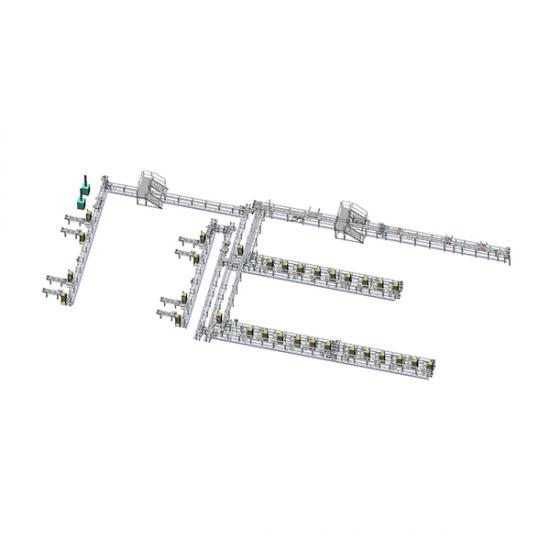
Automatic Material Conveying Line
#5. Final Assembly and Testing
Enclosure Sealing Machines: Assemble and seal the outer casing of the battery pack, protecting the internal components from environmental factors.
Charge/Discharge Test Equipment: Perform initial charge/discharge cycles to activate the electrochemical properties of the cells and verify the pack’s capacity and efficiency.
Environmental Stress Screening Chambers: Subject completed packs to extreme conditions such as temperature cycling, vibration, and shock tests to ensure durability and safety.
Insulation Resistance Testers: Check for proper insulation and prevent short circuits or electrical hazards.
#6. Quality Control and Traceability
Automated Optical Inspection Systems: Inspect the assembled packs for defects, misalignments, or foreign objects.
Data Logging and Traceability Systems: Track every step of the manufacturing process, including material sources, test results, and any adjustments made, providing full traceability for quality assurance and compliance purposes.
Ancillary Equipment and Considerations
Safety Gear: Personal protective equipment (PPE) and safety protocols are crucial due to the high voltage and potential fire hazards associated with battery pack assembly.
Software for Process Monitoring and Control: Facilitates realtime monitoring, predictive maintenance, and data analysis to optimize production efficiency and product quality.
Training Programs: Continuous training for staff on new technologies, safety procedures, and quality standards ensures the highest level of craftsmanship and adherence to regulations.
By integrating these stages and equipment into a cohesive prismatic cell pack line, manufacturers can produce highquality battery packs that meet the demanding requirements of modern applications. This not only enhances the performance and lifespan of the batteries but also ensures their safety and reliability in various environments, from consumer electronics to largescale energy storage solutions. Additionally, focusing on automation, quality control, and continuous improvement helps in scaling up production efficiently while maintaining high standards of product quality.



 Obsługiwana sieć IPv6
 pl
pl en
en fr
fr de
de ru
ru es
es pt
pt ko
ko tr
tr th
th


