Xiamen Tmax Battery Equipments Limited was set up as a manufacturer in 1995, dealing with lithium battery equipments, technology, etc. We have total manufacturing facilities of around 200000 square foot and more than 230 staff. Owning a group of experie-nced engineers and staffs, we can bring you not only reliable products and technology, but also excellent services and real value you will expect and enjoy.
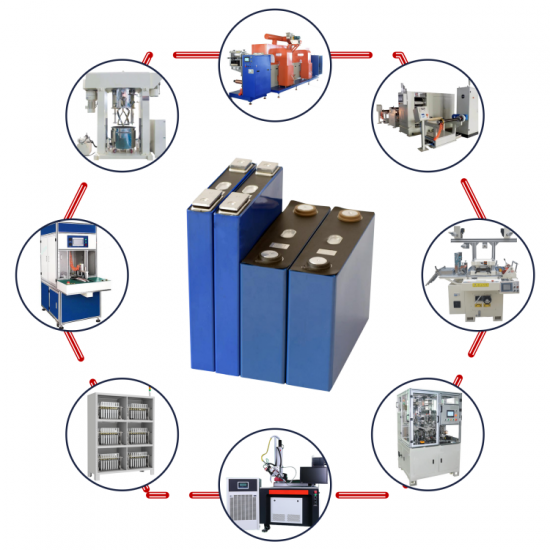
Prismatic cell production involves the manufacturing of lithiumion batteries in a prismatic form factor, which is characterized by its flat, rectangular shape. Prismatic cells are favored for their efficient use of space and ease of assembly into larger battery packs, making them popular in applications such as electric vehicles (EVs), energy storage systems (ESS), and portable electronics. Below is an overview of the key stages and equipment involved in prismatic cell production:
Key Stages of Prismatic Cell Production
#1. Electrode Preparation
Mixing Systems: Blend active materials (cathode or anode), binders, conductive additives, and solvents into uniform slurries.
Coating Machines: Apply these slurries onto metal foils (aluminum for cathodes, copper for anodes) using slotdie coaters or doctor blade systems.
Drying Ovens: Remove solvents from the coated electrodes under controlled conditions to ensure uniform drying.
Calendering/Rolling Mills: Compress the dried electrode sheets to achieve the desired thickness and density.
#2. Electrode Cutting and Slitting
Slitting Machines: Cut the coated and dried electrode sheets into precise widths suitable for stacking in prismatic cells.
DieCutting Machines: Further process the slitted electrode strips into shapes tailored for assembly into prismatic configurations.
#3. Assembly Line
Stacking Machines: Assemble cathode, anode, and separator layers into stacks rather than winding them into jelly rolls. This stacking method is typical for prismatic cells.
Insertion Tools: Guide the stacked electrode assemblies into prismatic casings.
Electrolyte Filling Systems: Include vacuum chambers or automated fillers that inject electrolyte into the casing while maintaining a moisturefree environment.
Sealing Machines: Hermetically seal the top cap onto the casing after electrolyte filling, ensuring no leaks occur.
#4. Formation and Testing
Formation Chargers/Dischargers: Charge and discharge newly assembled cells under controlled conditions to activate their electrochemical properties and evaluate initial performance metrics.
Battery Cyclers: Perform extensive charge/discharge cycles over time to assess capacity, efficiency, cycle life, and other critical parameters.
Impedance Spectroscopy Instruments: Measure internal resistance and other electrical characteristics.
Environmental Test Chambers: Simulate various environmental conditions to test thermal stability and safety.
Automatic Prismatic Cell Production Line
#5. Quality Control and Safety Testing
Automated Optical Inspection Systems: Check for defects such as misalignments, cracks, or foreign particles.
Safety Test Equipment: Conduct tests like overcharge, short circuit, nail penetration, and crush tests to ensure the safety of the cells under extreme conditions.
Data Management Systems: Track production data, analyze quality control metrics, and manage maintenance schedules to ensure continuous improvement and compliance with industry standards.
Ancillary Equipment and Considerations
Glove Boxes: Controlled environments filled with inert gas (e.g., argon) for handling moisturesensitive materials during processes like electrolyte filling.
Precision Scales: Highresolution balances for accurately weighing small quantities of materials.
Software for Process Monitoring and Control: Facilitates realtime monitoring and adjustments, predictive maintenance, and data analysis to optimize production efficiency and product quality.
Special Considerations for Prismatic Cells
Thermal Management: Due to their design, prismatic cells can be more challenging to cool uniformly compared to cylindrical cells. Efficient thermal management strategies are crucial to prevent overheating and ensure longterm reliability.
Mechanical Stability: The prismatic design offers better mechanical stability and less wasted space when assembling into modules or packs, but it requires careful engineering to avoid issues like swelling or deformation.
Scalability: While the prismatic format offers advantages in certain applications, scaling up production may involve higher initial costs due to specialized machinery and more complex assembly processes.
By focusing on these aspects, manufacturers can produce highquality prismatic lithiumion cells that meet the demands of modern applications requiring compact, highcapacity energy storage solutions.



 Obsługiwana sieć IPv6
 pl
pl en
en fr
fr de
de ru
ru es
es pt
pt ko
ko tr
tr th
th


